Jacaerys Velaryon
Fire & BloodJacaerys Velaryon, known to his family and friends as Jace, was the eldest son of Rhaenyra Targaryen and the heir she named to the Iron Throne. His short life joined private questions of parentage to public questions of succession: as a boy he was mocked as a bastard, while as a young prince he carried his mother’s cause across Westeros and secured alliances that helped shape the Dance of the Dragons. He died in the Battle in the Gullet before he could inherit the crown for which he had been designated.
Birth, lineage, and succession
Jacaerys was born in the closing days of 114 AC, after Rhaenyra announced that she was with child. He was described as a large, sturdy infant, with brown hair, brown eyes, and a pug nose. These features differed from those of his legal father, Laenor Velaryon, whose silver-white hair, purple eyes, and aquiline nose were associated with his Valyrian ancestry. Lord Corlys Velaryon overruled Laenor’s proposed name of Joffrey and gave the child the traditional Velaryon name Jacaerys; Jace became the familiar form used by his friends and brothers.
The difference in appearance fed persistent rumors that Rhaenyra’s sons were fathered not by Laenor but by Harwin Strong. The allegations were especially important because Jacaerys and his brothers stood within the line of succession. The question was never settled in the account: rumors and physical resemblance supplied grounds for suspicion, not a conclusive answer. King Viserys nevertheless continued to recognize Rhaenyra as his heir and her sons as heirs after her.
The king’s recognition was made visible through the royal custom of placing dragon eggs in the cradles of the Velaryon boys. Those who doubted the boys’ paternity predicted that the eggs would not hatch. Instead, three dragons emerged: Vermax for Jacaerys, Arrax for Lucerys, and Tyraxes for Joffrey. The hatchlings did not resolve the disputed parentage, but they strengthened the princes’ visible association with dragonriding and the Targaryen dynasty. Septon Eustace reported that Viserys once seated Jacaerys on his knee atop the Iron Throne while holding court and indicated that the boy would one day occupy it.
Childhood and family rivalries
Rhaenyra’s sons grew up amid the hostility between their mother and Queen Alicent Hightower. That enmity passed into the next generation. Alicent’s sons—Aegon II, Aemond Targaryen, and Daeron Targaryen—became bitter rivals of their Velaryon nephews, resenting what they regarded as the nephews’ claim to their birthright. The boys attended the same court gatherings, sometimes trained in the same yard, and studied under the same maesters. Their enforced proximity did not make them brothers in feeling; it intensified their mutual dislike.
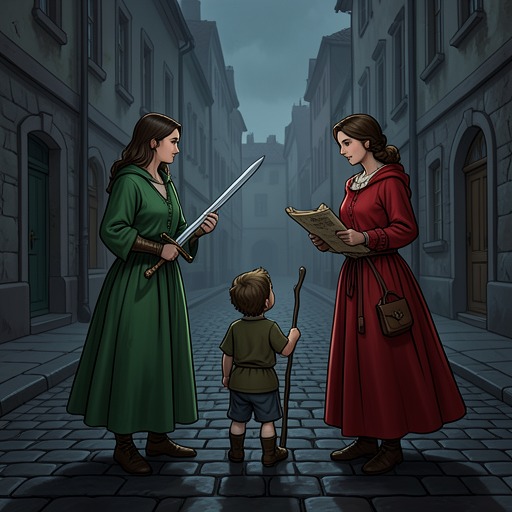
The conflict became open after Aemond claimed Vhagar. Joffrey ran to summon Jacaerys and Lucerys, and the three younger boys confronted Aemond with wooden swords from the training yard. Aemond fought them off and taunted the Velaryon boys as Strongs, invoking the allegation about their parentage. The quarrel escalated when Lucerys injured Aemond and Aemond lost an eye. Jacaerys was part of the confrontation and of the family dispute that followed, although the accusations were directed at the boys collectively.
Viserys tried to contain the consequences by requiring apologies and forbidding retaliation. Alicent demanded punishment for Lucerys, while Rhaenyra sought to discover who had spread the claim that her sons were Strongs. Aemond named Aegon II as the source; Aegon’s response was that the truth was widely known. Viserys ended the questioning, refused to order anyone’s eyes put out, and threatened punishment for anyone who repeated the insult. The attempted reconciliation did not restore trust. The king sent Alicent and her sons back to court, while Rhaenyra and her sons withdrew to Dragonstone.
Tension surfaced again at a feast held to celebrate Viserys’s recovery in 127 AC. Mushroom reports that Aemond raised a mocking toast to the Velaryon brothers’ strength. Later, Aegon II took offense when Jacaerys asked Helaena Targaryen to dance, and the exchange might have become a fight had the Kingsguard not intervened. The account presents these incidents as Mushroom’s report, not as an uncontested court record. Rhaenyra and her sons returned to Dragonstone the following morning.
Betrothals and dynastic ties
Jacaerys’s family position was also expressed through marriage arrangements. With Viserys’s approval, Rhaenyra betrothed her two eldest sons to the daughters of Daemon Targaryen and Laena Velaryon in 118 AC. Jacaerys was four and his intended bride, Baela Targaryen, was two. The arrangement linked Rhaenyra’s sons to Daemon’s branch of the family, joining a personal bond between the households to the political interests of the succession.
His later negotiations with the North created another prospective marriage alliance. At White Harbor, Desmond Manderly recalled that his family had once expected Princess Viserra to marry his ancestor, a promise that had lapsed after her death. Jacaerys understood that the lord was seeking a renewed connection between the houses. A compact was drawn up under which Manderly’s youngest daughter would marry Jacaerys’s younger brother Joffrey after the war. The agreement made Jacaerys’s diplomacy a matter not only of oaths and military support but of future kinship.
Envoy for Rhaenyra
When Rhaenyra’s council considered how to win support after the rival coronations, Jacaerys proposed that he and Lucerys carry messages themselves. He argued that dragons could persuade lords more quickly than ravens. Lucerys supported the plan, reasoning that seeing them ride dragons would counter the charge that they were Strongs. Corlys Velaryon grumbled that the boys were Velaryons, though the account describes pride in his response. Their identities were thus both a source of political vulnerability and something their dragonriding could publicly assert.
Rhaenyra allowed the mission only on strict terms. Jacaerys, then fourteen, and Lucerys, thirteen, had to swear on a copy of The Seven-Pointed Star that they would act as messengers, not take part in fighting. Jacaerys was assigned the longer and more dangerous route: first to the Vale, then White Harbor, and finally Winterfell. Lucerys was sent to Storm’s End. Before the brothers departed, Ser Steffon Darklyn arrived on Dragonstone with the crown of Jaehaerys the Conciliator, which he had brought from King’s Landing. Daemon placed it on Rhaenyra’s head, and she named Jacaerys Prince of Dragonstone and heir to the Iron Throne.
Jacaerys flew north on Vermax. At the Eyrie, he met Jeyne Arryn, who pledged the Vale to Rhaenyra; her warriors swore their swords as well. He then stopped at Sisterton, where Lord Borrell and Lord Sunderland pledged the support of the Three Sisters. At White Harbor he negotiated the marriage compact for Joffrey and the Manderly daughter. His final destination was Winterfell, where he reached an accord with Cregan Stark.
The agreement with Cregan, called the Pact of Ice and Fire, was to be sealed by a future marriage. Jacaerys had no children at the time, but the pact provided that his firstborn daughter would be sent to Winterfell at seven to be fostered there until she was old enough to marry Cregan’s heir. When Jacaerys left Winterfell, he had secured three powerful lords and their bannermen for his mother. Though his fifteenth nameday was still half a year away, the account presents the mission as proof that he had shown himself capable of the responsibilities of an heir.
Death and narrative significance
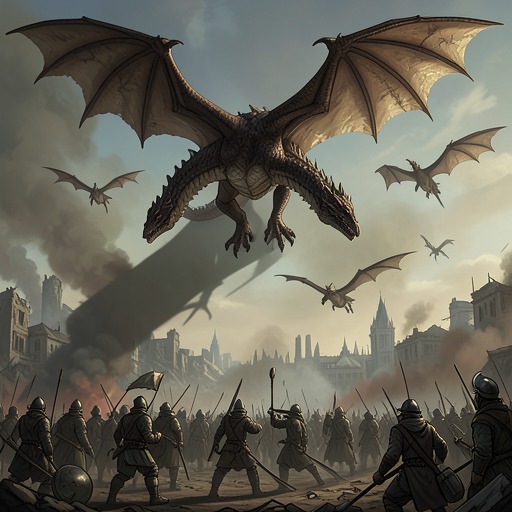
Jacaerys returned to the war as the conflict widened. In the Battle in the Gullet, he flew Vermax while the Velaryon fleet fought the allied forces of the Triarchy. Vermax fell during the battle, and Jacaerys was struck by crossbow fire after leaving the dragon. He was swallowed by the sea. His death deprived Rhaenyra of her eldest son and designated successor at a moment when the war was already exacting a heavy toll. Driftmark suffered devastating losses in the same battle, but the account singles out Jacaerys’s death as the loss felt most deeply.
Jacaerys’s arc turns on the distance between being named an heir and being accepted as one. His appearance made him a target for claims that he lacked the parentage required by his position; Viserys’s recognition, his dragon, and his formal designation supplied public counterweights, but did not silence the dispute. His embassy offered a different kind of answer. Through restraint, negotiation, and marriage compacts, he gained allegiance for Rhaenyra without leading an army. The mission ended not in inheritance or reconciliation, but in his death at sea, leaving the political future he had helped secure to be fought over by others.